Stem Cell Process
Isolation process and facility
Where the cells are handled, on what equipment, and how long it takes. The process is published as it is.
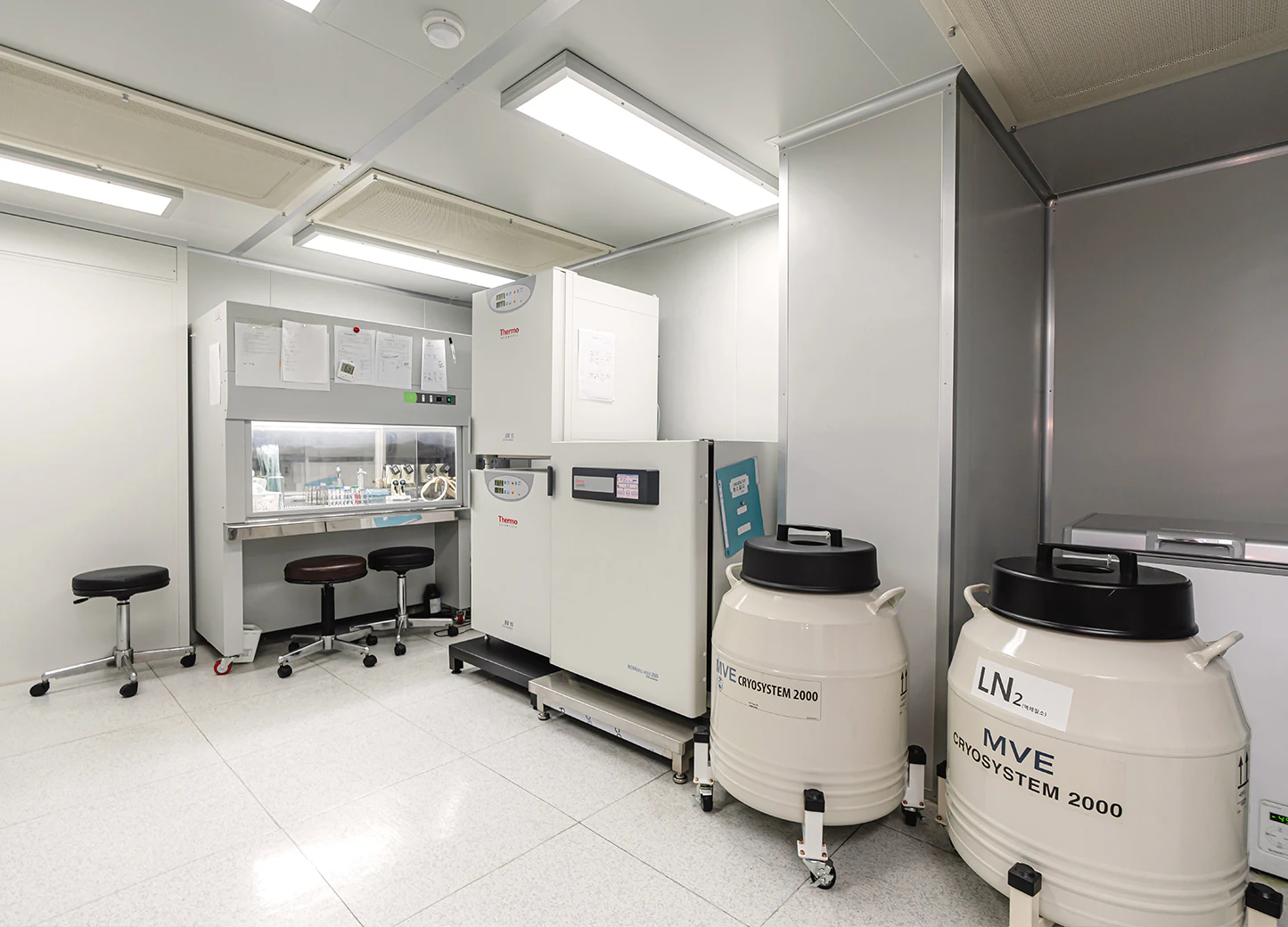
Seoul Stem Cell Lab handles cells inside a clean zone managed with an air shower and HEPA filtration. Automated extraction equipment and a cell separation unit isolate concentrated adipose-derived stem cells within 45 minutes, all open handling takes place in a double-filter clean bench, and a high-precision microscope and cell counter confirm the number and condition. Cells that are not used are stored in liquid nitrogen tanks at -196℃.
The same-day process
Harvesting through to treatment happens on one day, with no step where the sample is transported.
Fat harvesting
Performed under sedation in the 6th-floor operating room. The middle layer, where living cells are concentrated, is selected. The directing surgeon does this personally.
Enzymatic separation
GMP-grade collagenase releases the cells by breaking down the bonds in the adipose tissue. Temperature and duration are held constant.
Isolation and purification
The separation unit centrifuges the sample, removes fat cells and residue, and recovers only the stem cell layer. Everything to this point finishes within 45 minutes.
Counting and inspection
A cell counter gives the number and a microscope shows the condition. Only cells that pass this check are used, and the rest go into storage.
What the lab holds
The equipment is roughly six times the scale of a general stem cell laboratory (institution's own description).
Automated extraction system
Extracts cells from adipose tissue automatically, reducing the variation that comes with manual handling.
Cell separation unit
Isolates and purifies concentrated adipose-derived stem cells within 45 minutes. This is why same-day treatment is possible.
Double-filter clean bench
Every open handling step is done inside it, sealed off from the surrounding air.
Air shower and HEPA filtration
Airborne particles are removed on entry and the room air is filtered continuously.
High-precision microscope
Shows the shape and condition of the isolated cells, including damage that a number alone would not reveal.
Cell counter
Counts the cells. The lab reports a precision of over 90 percent.
HEPA-filtered incubator
Used for cell condition management and research. It is not used to expand cells for treatment.
Liquid nitrogen tanks
Freeze and store autologous cells at -196℃, under a 24-hour management system.
Equipment specifications and scale are as described by the institution. The number and activity of cells actually obtained vary with age, body composition and harvesting site, and equipment alone does not determine the outcome.
Aseptic management
Cells are vulnerable to contamination, so air, surfaces and the movement of people are managed separately.
Work in the clean bench
Every step where cells are exposed to air happens inside a double-filter clean bench.
Constant temperature and humidity
The zone the cells stay in is held at a constant temperature and humidity, with no change in transit.
Storage monitoring
Liquid nitrogen tanks are managed around the clock, and stored cells are identified and tracked per individual.
How long it takes from harvest to treatment
The longer cells spend outside the body, the worse their condition gets. Here is the time each step takes.
| Step | Where | Time | What it decides |
|---|---|---|---|
| Fat harvesting | 6F operating room | 30 min to 1 hour by site | The proportion of cells still alive |
| Transfer to the lab | 6F to 5F | Immediate | No temperature change in transit |
| Enzymatic separation | 5F clean bench | Fixed conditions | Recovery rate and degree of damage |
| Centrifugation and purification | 5F | Within 45 minutes | Recovery of the concentrated cell layer |
| Counting and inspection | 5F | About 10 minutes | Whether to proceed, and any change of plan |
| Treatment or storage | By purpose | Same day | Remaining cells stored at -196℃ |
These times are for the standard process and can vary with the amount harvested and the purpose of the treatment.
Questions about the process
Is 45 minutes enough? Would longer processing be better?
The longer cells stay outside the body, the worse their condition becomes. A longer isolation process means more time exposed to enzyme and more waiting, so once the necessary steps are done it is better to finish quickly.
45 minutes is the time needed to complete isolation and purification, and no step is skipped to shorten it.
How many cells will I get?
It varies widely with the amount harvested and with individual condition, so no single figure applies. Yield tends to fall with age and depends on body composition.
The counted value is confirmed before treatment, and if it falls short of the target the plan is adjusted on the spot.
How long can stored cells be used for?
At -196℃ in liquid nitrogen, cell metabolism is effectively halted. Storage period and extension follow the terms of the agreement, which are explained during consultation.
The proportion of cells recovered after thawing varies between individuals, and that is taken into account when deciding how much to store.
How do I judge whether aseptic management is real?
Two things: whether the zone is managed with an air shower and HEPA filtration, and whether work that exposes cells to air is done inside a clean bench.
Why is there an incubator if nothing is cultured?
Culturing and expanding autologous cells requires a separate regulatory route under Korean law on advanced regenerative medicine. The incubator is used for cell condition management and research purposes.